- Datawallet Daily
- Posts
- CZ Addresses Potential $4.3B Refund After Trump Pardon
CZ Addresses Potential $4.3B Refund After Trump Pardon
Newsletter Issue #673
 | Newsletter Issue #673 |
 | CZ Addresses Potential $4.3B Refund After Trump Pardon |
GM. CZ broke his silence on a potential $4.3B Binance refund post-Trump pardon, calling it “delicate question” and pledging to reinvest any repayment in America.
Meanwhile, Adam Back dismissed quantum fears for Bitcoin, 1inch unveiled its Aqua shared-liquidity protocol, and Hong Kong began testing tokenized interbank deposits.
Here's a breakdown of the latest crypto news. 👇
CZ Addresses Potential $4.3B Refund After Trump Pardon
Binance founder Changpeng “CZ” Zhao addressed questions on Sunday about whether the exchange will seek a refund of its $4.3 billion settlement fine. Speaking on X, Zhao called it a “delicate question,” adding he has not formally requested reimbursement from US authorities.
Zhao said that any refund, if granted, would be “invested in America to show our appreciation,” referencing his recent presidential pardon. The former Binance CEO served four months in prison in 2024 for anti–money laundering violations before receiving clemency from President Donald Trump last month.
CZ’s attorney Teresa Goody Guillén said on the “Pomp Podcast” last Friday that her client’s pardon was not “pay-to-play,” rejecting allegations of political favors. She argued Zhao was a “scapegoat for the war on crypto,” contrasting his treatment with leniency shown to traditional finance executives.
Critics including Sen. Elizabeth Warren and Rep. Maxine Waters denounced the pardon as “corruption,” citing Binance’s prior dealings with Trump-linked firms such as World Liberty. Democratic lawmakers have proposed measures to tighten oversight of crypto lobbying and restrict lawmakers from holding crypto.

Adam Back Says Bitcoin Safe From Quantum Threat
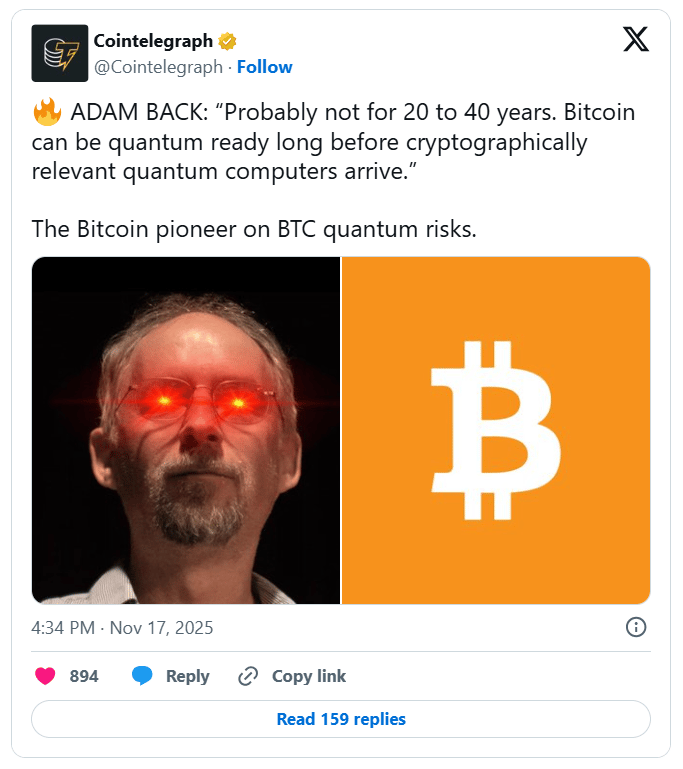
Blockstream CEO and Bitcoin pioneer Adam Back said quantum computers pose no risk to Bitcoin for decades. Responding on X to investor speculation, he estimated the technology remains twenty to forty years from cryptographic relevance. Back noted post-quantum encryption standards certified by NIST are ready for integration well before any practical attack emerges.
He explained current systems lack stable, noise-free qubits required to compromise Bitcoin’s SHA-256 encryption standard. Even advanced arrays like Caltech’s 6,100-qubit prototype cannot match theoretical thresholds needed for meaningful decryption. Back added that Bitcoin could adopt post-quantum protocols in time, preserving security long before quantum computing becomes a genuine threat.
1inch Launches Aqua Shared Liquidity Protocol
Decentralized exchange aggregator 1inch introduced Aqua, a shared-liquidity protocol designed to optimize capital efficiency across DeFi applications. Announced at Devconnect in Argentina, Aqua lets multiple strategies access the same funds without requiring users to lock deposits. Developers received early access to Aqua’s SDK and documentation to test integrations within the 1inch ecosystem.
Co-founders Anton Bukov and Sergej Kunz described Aqua as a foundation for composable, capital-efficient decentralized finance. The model replaces traditional pool deposits with self-custodial wallets that interact directly through automated instructions. 1inch said this design allows liquidity to be reused across protocols, reducing fragmentation and expanding the network’s aggregate trading depth.

Hong Kong Tests Tokenized Deposit Transactions in Pilot
The Hong Kong Monetary Authority began pilot trials for Project Ensemble, testing real-value tokenized deposits and digital-asset settlements. Officials said the program transitions from a sandbox to live interbank experiments supporting money-market transactions and liquidity management. The pilot will operate through 2026, integrating Hong Kong’s Real Time Gross Settlement system for initial tokenized transfers.
HKMA chief executive Eddie Yue said the initiative marks a critical milestone in Hong Kong’s digital-finance strategy. Regulators aim to demonstrate real-world settlement efficiency while preparing for 24/7 tokenized central bank money. The project complements regional efforts, with Singapore’s Monetary Authority also developing interoperable frameworks for cross-border tokenized deposit infrastructure.

Data of the day
Bitcoin’s mined supply surpassed 19.95 million coins, reaching 95% of its fixed twenty-one million limit. With fewer than 1.05 million BTC left, issuance continues to decline following the April 2024 halving. The milestone highlights Bitcoin’s predictable scarcity model, where miners earn diminishing rewards as block subsidies halve every four years.
Economists said Bitcoin’s controlled issuance cements its role as a deflationary, programmatic monetary system. Future halvings will slow supply growth below 1% annually, increasing reliance on transaction fees for miner revenue. Kraken economist Thomas Perfumo said this scarcity reinforces Bitcoin’s appeal as a neutral, borderless hedge against inflation and currency debasement.

More breaking news
Michael Saylor’s Strategy purchased 8,178 additional Bitcoin for $836 million, bringing total holdings to 649,870 BTC valued at approximately $62 billion overall.
NBA star Tristan Thompson said prediction markets will soon integrate into live sports broadcasts, combining real-time fan sentiment with wagering to boost engagement.
SOL Strategies will provide staking for VanEck’s new Solana ETF through its Orangefin validator, underscoring growing institutional interest in secure Solana infrastructure.
BitMine added 54,000 Ether worth $173 million while chairman Tom Lee cited liquidity shortages from a struggling market maker as the cause of weakness.
Crypto investment funds recorded $2 billion in outflows last week as uncertain monetary policy and large investor selling weighed heavily on overall sentiment.
Dutch central bank governor Olaf Sleijpen warned that dollar stablecoins are growing fast enough to threaten financial stability and potentially disrupt ECB policymaking.
US prosecutors said they presented sufficient evidence to convict Tornado Cash developer Roman Storm, opposing his post-trial motion seeking a full acquittal of charges.
The European Union removed mandatory message scanning from its Chat Control proposal but kept age checks and optional surveillance provisions sparking privacy concerns.
For the latest updates on digital asset markets, follow us on X @Datawalletcom.
