- Datawallet Daily
- Posts
- David Sacks Exits as Crypto Czar for White House Role
David Sacks Exits as Crypto Czar for White House Role
Newsletter Issue #767
 | Newsletter Issue #767 |
 | David Sacks Exits as Crypto Czar for White House Role |
GM. David Sacks exited his role as White House AI and crypto czar today, transitioning to co-chair the President’s Council of Advisors on Science and Technology.
Meanwhile, Governor Newsom banned prediction market insider trading, Tether hired KPMG for a full audit, and Canada moved to block crypto election donations.
Here are the details on personnel shifts, insider trading bans, and major audits. 👇
David Sacks Exits as Crypto Czar for White House Role
Former crypto and artificial intelligence czar David Sacks vacated his specialized administration post to co-chair the President’s Council of Advisers on Science and Technology. This high-profile transition shifts his focus toward broader technological advisory duties.
The strategic personnel move took place on 26 March 2026 within Washington D.C. as the executive's initial 130 day term as a special government employee concluded. These developments surfaced while extensive digital asset legislation faced fresh hurdles.
Sacks initiated this specific career pivot because he seeks to influence an extended range of technical topics including quantum computing and sovereign intelligence. By joining this council, he aligns with industry titans like Mark Zuckerberg and Larry Ellison.
The advisor achieved this transition by relinquishing his direct oversight of digital markets while maintaining influence over the broader United States innovation agenda. Consequently, his departure intensifies pressure on Congress to resolve stalled debates regarding stablecoin yield rewards.

Newsom Bans Prediction Market Insider Trading In California
Governor Gavin Newsom signed an executive order to prohibit California public officials from using confidential information for financial gain. This new state mandate immediately prevents political appointees from leveraging non-public data to place profitable wagers on various prediction platforms.
The governor emphasized that public service must never function as a personal scheme for accumulating wealth through unethical methods. The order further restricts state employees from sharing secret details with family members or business partners to facilitate third-party profits.
This follows intense scrutiny of several high-profile incidents where well-connected traders earned massive rewards on Polymarket shortly before major government interventions. Democratic lawmakers continue to push for similar federal legislation to prevent political insiders from exploiting their proximity to power.

Tether Appoints KPMG For First Full Financial Audit
Tether officially appointed the Big Four accounting firm KPMG to conduct a thorough financial audit of its stablecoin reserves. The company also hired PwC to prepare its internal systems for this rigorous examination of its $184 billion in circulating assets. This milestone marks the first time the issuer has moved beyond monthly attestations to seek a full independent audit.
CEO Paolo Ardoino stated that this high level of scrutiny is necessary to build long-term trust within the global finance industry. The audit seeks to verify the existence of the massive cash and treasury holdings that back the value of USDT. This transparency push occurs as the firm reportedly scales back its fundraising targets by 75% following a record-breaking year of profitability.

Canada Moves To Prohibit Cryptocurrency Election Donations
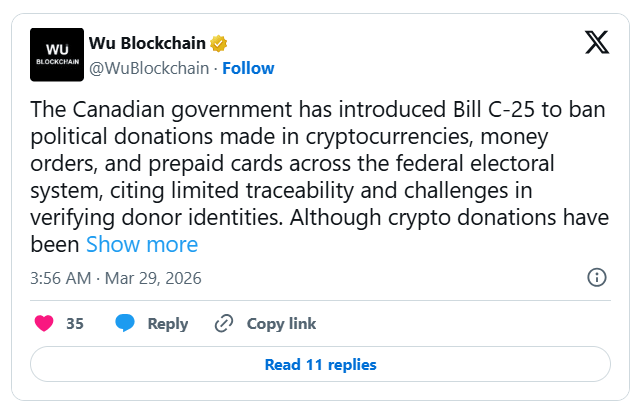
The Canadian federal government introduced Bill C-25 this week to ban all cryptocurrency contributions to political campaigns and leadership contests. This legislation classifies digital assets and prepaid payment products as untraceable funding sources that could potentially threaten the integrity of national elections. Lawmakers aim to close a theoretical vulnerability that might allow foreign money to influence domestic politics through anonymous channels.
The bill requires political recipients to destroy or return any prohibited digital contributions to the original sender within 30 days. Failure to comply with these new rules can result in administrative penalties reaching twice the value of the offending donation. While the United Kingdom recently implemented a similar moratorium, the United States continues to allow disclosed crypto donations for federal candidates.
Data of the day
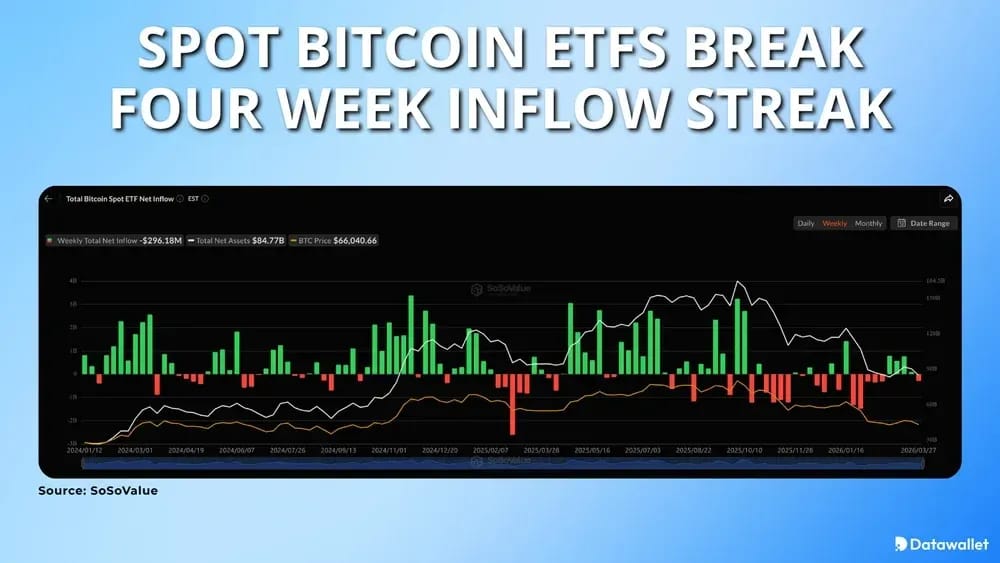
United States spot Bitcoin ETFs recorded $296 million in net outflows last week, ending a month-long streak of positive capital movement. This reversal followed back-to-back sessions of substantial redemptions on Thursday and Friday as investors reacted to ongoing macroeconomic uncertainty.
Trading volume also moderated sharply during this period, falling to roughly $14.26 billion from the much higher levels seen earlier this month. Analysts suggest that capital in Bitcoin ETFs is currently remaining cautious rather than exiting the market entirely due to unresolved geopolitical risks.
Bitcoin continues to trade within a range between $65,000 and $72,000 while reflecting broader liquidity conditions rather than showing a clear directional trend. Ethereum funds also struggled by extending an outflow streak that has persisted for two consecutive weeks of active trading.
More breaking news
An ECB study found that the top 100 holders control over 80% of governance tokens in major DeFi protocols like Uniswap and Aave.
GameStop pledged 4,709 BTC to a covered call strategy on Coinbase Prime, shifting the $315 million investment into a receivable asset for yield.
Gnosis and Zisk proposed the "Ethereum Economic Zone" to unify fragmented Layer 2 networks through synchronous composability and real-time zero-knowledge proving technology.
The Ethereum Foundation is co-funding a new framework to allow rollups to interact seamlessly with the mainnet within a single transaction.
Bittensor’s TAO surged 90% in March, driving ecosystem subnet tokens to a $1.5 billion market cap following key AI model performance milestones.
The World Foundation sold $65 million in WLD tokens at a steep discount to fund operations as prices hit a record low.
Intercontinental Exchange finalized a $1.6 billion investment in Polymarket, fulfilling a major commitment to the leading prediction market platform as competition intensifies.
Mastercard’s $1.8 billion acquisition of BVNK marks the largest stablecoin infrastructure deal to date, prioritizing the firm's extensive global regulatory licensing footprint.
For the latest updates on digital asset markets, follow us on X @Datawalletcom.
