- Datawallet Daily
- Posts
- Polymarket Cleared by the CFTC for United States Relaunch
Polymarket Cleared by the CFTC for United States Relaunch
Newsletter Issue #679
 | Newsletter Issue #679 |
 | Polymarket Cleared by the CFTC for United States Relaunch |
GM. Polymarket has been officially cleared by the CFTC to operate in the US, marking its transformation from offshore upstart to fully regulated prediction market exchange.
Meanwhile, Pump’s founder denied $436M cash-out claims, Berachain clarified Brevan Howard’s refund terms, and the whale behind October’s crash opened a $44.5M ETH long.
Regulatory wins, FUD responses, and bold bets headline midweek crypto. 👇
Polymarket Cleared by the CFTC for United States Relaunch
Polymarket received CFTC approval to operate as a fully regulated prediction market exchange in the United States. The Amended Order of Designation issued Monday permits intermediated trading through futures commission merchants and brokerage platforms under the Commodity Exchange Act.
The decision formalizes Polymarket’s compliance status after years offshore following a 2022 CFTC enforcement action halting US access. Founder and CEO Shayne Coplan said the approval affirms the platform’s maturity and transparency within America’s financial system.
As part of the authorization, Polymarket implemented upgraded surveillance, clearing procedures, and market supervision meeting designated contract market standards. The exchange will introduce intermediated access before reopening fully to retail and institutional participants this year.
Polymarket, which acquired CFTC-licensed exchange QCEX for $112 million in July, plans to onboard brokerages and institutional partners. The company reported billions in forecast volume across 2025 and aims to anchor prediction markets inside mainstream financial infrastructure.

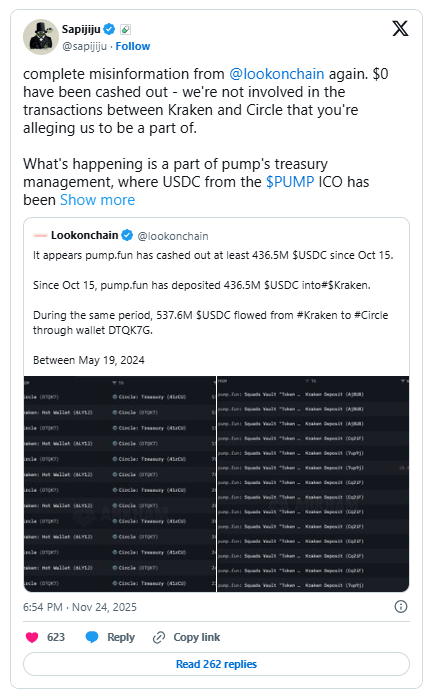
Pump Founder Denies $436M Cash-Out Allegations
PumpFun co-founder Sapijiju denied claims that the project liquidated $436 million in USDC, calling reports misinformation. He said the funds were redistributed internally for treasury management following the PUMP ICO, not transferred for profit-taking. Sapijiju emphasized that the tokens remain within company control and support ongoing operational reinvestments, not offloading to exchanges.
The transfer of funds coincided with declining monthly revenue, fueling community speculation about potential selling pressure and transparency concerns. Blockchain data still shows PumpFun wallets holding $855 million in stablecoins and $211 million in Solana. Analysts and users remain divided, with some demanding audits while others defend the company’s right to manage reserves.
Berachain Clarifies Brevan Howard $25M Refund Terms
Berachain founder Smokey The Bera disputed reports suggesting Brevan Howard received an unusual refund right on its $25 million investment. He said the provision applied only if Berachain failed to launch or list its token post-fundraise. Smokey added that Brevan Howard participated under identical terms as other investors during the blockchain’s Series B round.
The founder explained that Nova Digital sought added safeguards consistent with its liquid investment mandate, not preferential protection. Smokey said the side letter reflected standard commercial practice and included commitments to provide post-launch liquidity. Despite recent volatility, Brevan Howard remains a major Berachain tokenholder, having increased its exposure through secondary purchases.

Whale Behind October Crash Opens $44.5M ETH Long
A trader nicknamed the “OG Whale,” known for profiting $200 million from October’s crash, has opened $44.5 million in ETH longs. Data from Arkham Intelligence showed the unidentified whale adding $10 million Monday, extending prior leveraged exposure on Hyperliquid. Analysts said the move indicates renewed conviction that Ethereum’s price has reached a potential cyclical bottom.
The wallet remains unverified, though linked addresses show prior high-frequency trading activity across major exchanges. Market observers note that similar positions previously preceded sharp reversals in Ether pricing trends. With ETH near $2,900, sentiment among large traders has turned cautiously bullish as futures data signals improving momentum.

Data of the day
The long-short account ratio for Bitcoin perpetuals on Binance reached 3.87 last week, the highest level in three years. The metric tracks the share of large accounts net long versus short, highlighting a significant sentiment reversal among top traders. Analysts said whales are now heavily long following a 35% price decline from Bitcoin’s all-time high above $126,000.
Data suggests many large accounts flipped from short positions into accumulation during recent market weakness. Experts caution that this indicator reflects directional bias, not total notional exposure or risk-adjusted positioning. Still, the surge signals renewed confidence in Bitcoin’s near-term recovery as leveraged traders reposition for a potential rebound.

More breaking news
Kraken expanded its Krak app with cashback debit cards, salary deposits, and high-yield vaults, positioning it as a crypto-native alternative to traditional banking.
South Korea’s stablecoin framework faces further delays as regulators clash over whether banks must control issuers, leaving competing legislative drafts under review.
Spot Solana ETFs marked twenty consecutive days of inflows totaling $568 million, signaling strong institutional demand despite market-wide risk-off sentiment in digital assets.
Strategy paused its routine Bitcoin purchases as shares trade 67% below last year’s highs, while analysts warn of potential MSCI index exclusion early next year.
Galaxy Digital is in talks to provide liquidity for Polymarket and Kalshi, expanding into prediction markets amid $42 billion in cumulative trading volume.
MoonPay gained a New York Trust Charter, joining Coinbase and PayPal among firms authorized to custody digital assets and offer institutional crypto trading services.
Japan’s Financial Services Agency will propose new rules requiring crypto exchanges to maintain liability reserves, strengthening investor protection after major domestic hacks.
VanEck removed staking plans from its BNB ETF filing, citing regulatory uncertainty as the fund manager distances itself from potential securities classification risks.
For the latest updates on digital asset markets, follow us on X @Datawalletcom.
