- Datawallet Daily
- Posts
- SEC Chair Declares Most Crypto Tokens Non-Securities
SEC Chair Declares Most Crypto Tokens Non-Securities
Newsletter Issue #670
 | Newsletter Issue #670 |
 | SEC Chair Declares Most Crypto Tokens Non-Securities |
GM. SEC Chair Paul Atkins said most crypto tokens (including Ethereum, Solana, and meme coins) are not securities, signaling a sweeping regulatory shift toward innovation.
Meanwhile, Bybit found 16 blockchains with built-in freeze controls, Circle is weighing an Arc token as USDC surges, and Visa is piloting USDC payments for gig workers.
Here are the latest news on regulations, decentralization, and digital payments. 👇
SEC Chair Declares Most Crypto Tokens Non-Securities
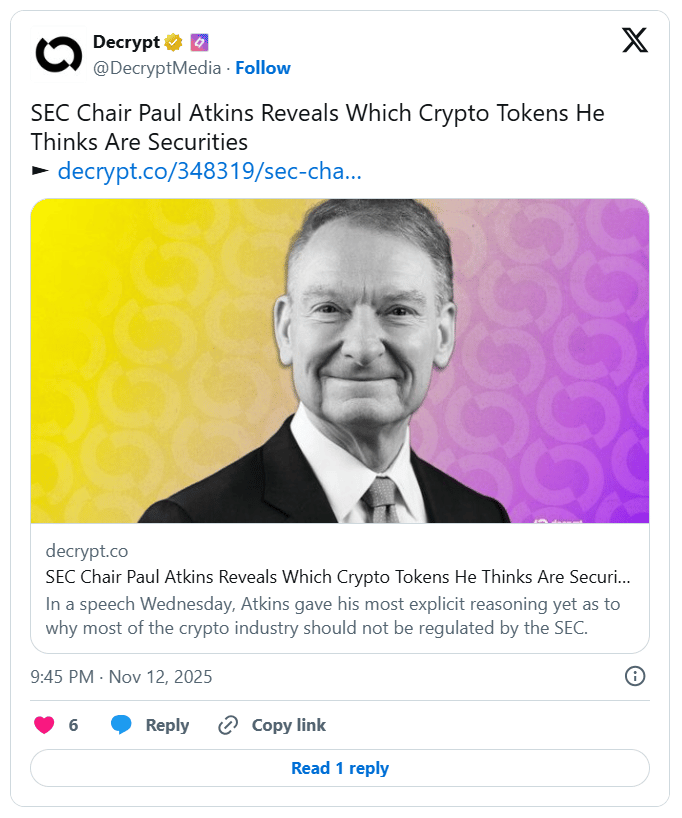
SEC Chair Paul Atkins said that most cryptos, including network tokens, meme coins, and digital collectibles, should not be classified as securities. In a speech outlining the agency’s narrowed jurisdiction, he argued only tokens tied to explicit and unambiguous managerial promises qualify under securities law.
Atkins clarified that tokens like Ethereum, Solana, and XRP, as well as meme coins referencing cultural trends, fall outside SEC oversight. He added that digital tools such as tickets, memberships, and badges represent practical utilities rather than investment contracts requiring regulatory supervision.
The chair’s remarks mark the clearest articulation yet of his pro-innovation stance under the second Trump administration. Atkins emphasized that assets should only be considered securities when their value depends on the managerial efforts of identifiable issuers.
Atkins also announced plans for “super app” trading platforms allowing securities and non-securities to coexist beyond traditional SEC-regulated venues. He said the agency’s mandate was never meant to police every novel form of value, reaffirming crypto’s regulatory independence.
Bybit Research Finds 16 Blockchains Able to Freeze Funds
Bybit’s Lazarus Security Lab identified 16 networks capable of freezing or restricting user funds through embedded mechanisms. The exchange said the analysis, published on Tuesday, examined 166 blockchains and found hardcoded or configuration-based controls in systems such as BNB Chain.
The report also found Cosmos-based chains could introduce fund freezing with relatively minor protocol adjustments to module accounts. Researchers detailed three technical approaches enabling fund restrictions, including hardcoded blacklists, configuration files, and smart contract-level freezes.
Ten of the sixteen chains use validator-managed configuration files, while five include freeze functions directly in source code. Bybit warned that even preventive systems raise deeper concerns about decentralization, censorship, and governance transparency across major blockchain ecosystems.

Circle Considers Arc Token as USDC Supply Surges
Circle said it is evaluating a native token for its Arc blockchain after reporting strong third-quarter financial results. The firm’s earnings showed USDC circulation doubling year over year and total revenue reaching seven hundred forty million dollars. Management said a potential Arc token would expand programmable finance features across the network’s onchain payment and capital markets systems.
The company highlighted rising institutional adoption through its Circle Payments Network and tokenized money market fund USYC. Analysts noted USDC now leads onchain growth versus Tether’s USDT amid growing preference for regulated stablecoins. Circle forecast continued revenue growth into 2025 as policy clarity and institutional demand support broader stablecoin adoption in cross-border payments.
Visa Pilots USDC Payments for Creators and Gig Workers
Visa announced a pilot program allowing companies to send fiat payments that recipients receive in Circle’s USDC stablecoin. The initiative, unveiled on Monday, targets gig and creator economy platforms that distribute small, recurring payments to global workers. Eligible users will need stablecoin wallets and identity verification, with the rollout planned for late 2026 pending approval.
The program expands Visa Direct’s infrastructure, connecting conventional rails to blockchain settlement layers using Circle’s technology. The company said it expects faster settlement times and lower cross-border transaction costs for digital creators and freelancers. Visa has been investing heavily in stablecoin partnerships this year, including integrations with Stripe’s Bridge unit and fintech firm Rain.

Data of the day
Zcash’s shielded pool now holds 23% of circulating supply, up from 18% in October. Analysts said the increase highlights growing user adoption of privacy features amid renewed attention to onchain anonymity tools. The rise coincides with a price rally that lifted ZEC from four hundred to seven hundred fifty dollars this month.
Researchers said the growth in shielded balances parallels Ethereum’s staking ratio as a measure of network participation. Active shielding activity suggests genuine protocol use beyond speculative trading, supported by record exchange volumes across Coinbase and Binance. The correlation between network usage and price momentum indicates strengthening fundamentals in Zcash's ecosystem.

More breaking news
Polymarket became Yahoo Finance’s exclusive prediction market partner days after Google’s integration, as trading volume surged toward another record month.
Kraken co-CEO Arjun Sethi warned that the UK’s strict crypto promotion rules and excessive risk warnings could ultimately harm rather than protect retail investors.
Coinbase ended its planned $2 billion acquisition of stablecoin startup BVNK, halting one of crypto’s largest proposed infrastructure deals without citing a reason.
Biotech firm Leap Therapeutics rebranded to Cypherpunk Technologies after buying $50 million in Zcash, pivoting to a Winklevoss-backed digital asset treasury strategy.
Bitcoin ETFs added $524 million in daily inflows, their strongest in a month, bringing total net inflows to $61 billion since January’s debut.
Sonic shifted from touting transaction speed to focusing on institutional adoption, token supply cuts, and long-term business value through a US expansion.
The DTCC listed Bitwise’s spot Chainlink ETF under ticker CLNK as XRP ETFs near approval, signaling broader altcoin ETF launches beyond Bitcoin and Ether.
JPYC said yen stablecoin issuers could soon become major Japanese government bond buyers, filling liquidity gaps as the Bank of Japan slows its purchases.
.
For the latest updates on digital asset markets, follow us on X @Datawalletcom.
