- Datawallet Daily
- Posts
- SEC Ends Four-Year Aave Investigation After Review
SEC Ends Four-Year Aave Investigation After Review
Newsletter Issue #695
 | Newsletter Issue #695 |
 | SEC Ends Four-Year Aave Investigation After Review |
GM. The SEC has closed its four-year investigation into Aave without enforcement, marking a major win for DeFi and signaling further easing of US regulatory pressure under the Trump administration.
Hyperliquid proposed a $1 billion assistance fund vote, Solana tested quantum-resistant signatures, and DTCC launched a pilot for tokenized Treasurys after SEC approval.
Here are the latest crypto news that you might’ve missed. 👇
SEC Ends Four-Year Aave Investigation After Review
The US Securities and Exchange Commission ended a four-year investigation into DeFi protocol Aave, confirmed by founder Stani Kulechov on Tuesday. An Aug 12 letter said regulators would not recommend enforcement action after reviewing the platform.
Kulechov said the closure ends what he called longstanding unfair regulatory pressure facing decentralized finance builders globally. The decision follows the SEC dropping or pausing about 60% of crypto cases since January under President Donald Trump.
Public records showed no Wells notice was issued, signaling the probe never reached formal charges against the protocol. Following the disclosure, AAVE rose more than 3% within 24 hours as traders priced relief across decentralized finance markets.
The outcome adds momentum to a regulatory thaw benefiting Aave alongside Uniswap, Gemini, and Ripple after years of scrutiny. Developers now see clearer footing to build lending and onchain markets without looming US enforcement threats for the sector.

Hyperliquid Vote Targets $1 Billion Assistance Fund
Hyper Foundation proposed a validator vote to classify Assistance Fund HYPE tokens as permanently inaccessible within protocol accounting. The Assistance Fund automatically converts trading fees into HYPE tokens routed to a system address holding about $1 billion. Because the address lacks control mechanisms, the tokens cannot be retrieved without a hard fork, according to documentation.
The vote would clarify circulating supply metrics rather than reduce total issuance or retroactively burn existing tokens. Institutional interest has increased as Hyperliquid generated roughly $874 million in fees year-to-date during 2025. Nearly 99% of protocol fees are routed into automated HYPE repurchases through the Assistance Fund mechanism.

Solana Tests Quantum Resistance With Project Eleven
The Solana Foundation partnered with Project Eleven to test post-quantum cryptography across a prototype Solana testnet. Project Eleven conducted a full quantum threat assessment and implemented quantum-resistant digital signatures for transaction processing. The foundation said results demonstrated scalable, end-to-end quantum-resistant transactions despite higher computational requirements.
The pilot follows NIST approving post-quantum standards FIPS 203, 204, and 205 in August 2024. Research shows FIPS 204 signatures cost nearly five times more to sign than Ed25519 but verify faster. Solana said preparations aim to mitigate long-term cryptographic risks as quantum computing capabilities evolve.

DTCC Launches Onchain Treasury Pilot After SEC Approval
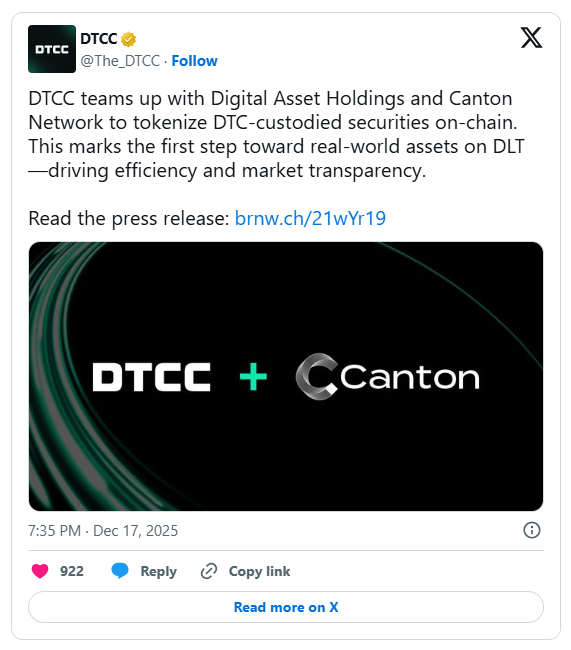
DTCC will pilot tokenized representations of US Treasurys held at its depository under SEC-approved conditions. The project uses Digital Asset’s Canton Network to tokenize ownership entitlements while securities remain on DTCC’s ledger. Participants can convert Treasury entitlements into blockchain-based tokens without altering custody or settlement frameworks.
The pilot begins in the first half of 2026 and may expand pending regulatory and client feedback. DTCC executives emphasized maintaining legal certainty while exploring efficiency gains from tokenization technology. Tokenized US Treasurys already total about $9 billion, driven by demand for onchain dollar-denominated yield.
Data of the day
Cohort data shows Polymarket retains users better than over 85% of crypto platforms analyzed. The study tracked monthly returning users across 275 networks, DeFi protocols, wallets, and exchanges. Analysts found sustained engagement remains rare across crypto despite strong user acquisition trends.
Prediction markets benefit from event-driven engagement tied to elections, sports, and economic data releases. This structure encourages repeated participation without relying heavily on incentives or volatility cycles. As retention struggles persist, exchanges and wallets increasingly integrate prediction platforms like Polymarket to drive habitual usage.

More breaking news
President Trump will interview pro-crypto Fed Governor Christopher Waller for the next Federal Reserve Chair role, signaling potential policy realignment.
Bhutan pledged 10,000 Bitcoin worth $1 billion to fund Gelephu Mindfulness City, underscoring its long-term commitment to sovereign digital reserves.
Tether launched PearPass, a peer-to-peer password manager with no cloud storage, expanding into decentralized consumer tools to strengthen digital privacy.
Meme coin trading collapsed to $5 billion daily volume, marking an 80% decline since 2024’s $150 billion peak as hype evaporated.
Binance offered a $5 million whistleblower bounty to expose fraudulent “listing agents,” tightening its token listing process amid rising impersonation scams.
Bitcoin miner Hut 8 signed a $7 billion Google-backed AI data center lease, deepening its pivot toward institutional artificial intelligence infrastructure.
Exodus partnered with MoonPay and M0 to launch a fully reserved US dollar stablecoin powering its payment ecosystem beginning in early 2026.
For the latest updates on digital asset markets, follow us on X @Datawalletcom.
