- Datawallet Daily
- Posts
- Zcash Developers Resign Following Board Governance Clash
Zcash Developers Resign Following Board Governance Clash
Newsletter Issue #711
 | Newsletter Issue #711 |
 | Zcash Developers Resign Following Board Governance Clash |
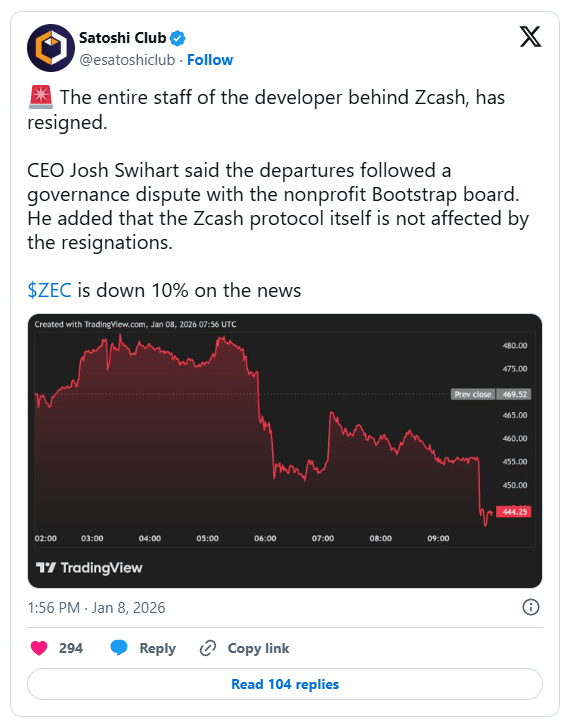
GM. Zcash core developers abruptly resigned after a board clash, tanking the ZEC token by 18% and leaving the protocol’s specialized engineering team to launch a new rival venture.
Meanwhile, Monero hit $460 as capital fled Zcash, the EU launched strict DAC8 crypto tax rules, and Binance debuted gold and silver perpetuals via its Abu Dhabi entity.
Here are the details on privacy wars, regulatory shifts, and commodity trading. 👇
Zcash Developers Resign Following Board Governance Clash
CEO Josh Swihart and his entire Electric Coin Company workforce abruptly resigned after a vitriolic governance schism with their nonprofit board directors. These core privacy architects abandoned the protocol's primary development firm to launch a new venture.
The mass exodus occurred on 7 January 2026 within the United States digital asset sector during a period of high volatility. This institutional fracture immediately triggered a sharp 18% decline in the market value of the ZEC token.
Leadership cited constructive discharge after the Bootstrap board allegedly imposed intolerable employment terms that compromised the team's professional integrity. Directors countered that the dispute stemmed from risky proposals to privatize the Zashi wallet for potential private benefit.
The departing engineers intend to continue their mission by founding a separate entity dedicated to building unstoppable private money. Meanwhile, the open source Zcash network remains technically operational despite the sudden vacuum of its original specialized engineering talent.
Monero Reclaims Privacy Top Spot Amid Zcash Turmoil
Monero surged back toward its previous record highs this week as developers at Zcash suddenly resigned. The XMR token traded near $460 on Thursday while its primary competitor suffered a 15% price drop. Investors shifted capital into the veteran privacy coin following a leadership dispute at the Electric Coin Company.
The leadership exodus at Zcash has injected great uncertainty into the protocol roadmap for the 2026 season. Market participants chose Monero for its perceived stability despite previous concerns regarding network mining concentration last year. This rotation highlights a growing demand for privacy coins as major venture firms identify anonymity as a critical competitive moat.

EUs Tax Reporting Rules Ignite Fierce Privacy Debate
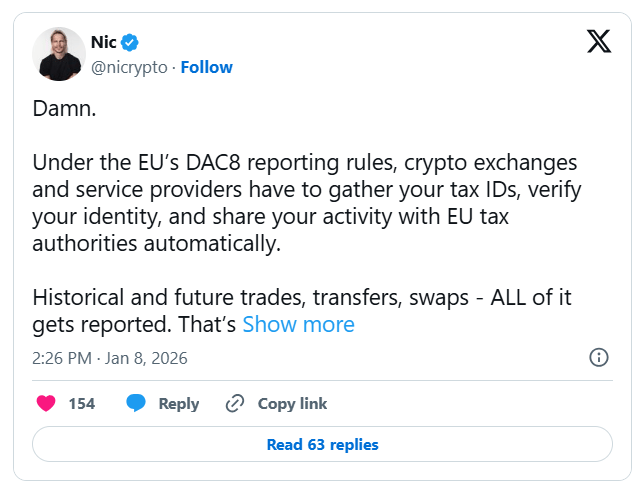
The new DAC8 crypto tax reporting regime officially launched across the European Union on January 1. This mandate requires centralized exchanges to share customer identities and transaction histories with national financial authorities annually. Many blockchain community members argue that these aggressive transparency rules signal the end of financial anonymity for European residents.
Proponents of the law suggest that the directive only impacts custodial platforms rather than private digital wallets. Officials believe the data exchange will help close compliance gaps created by the borderless nature of crypto markets. However, critics worry about the automated international information sharing and its impact on users in regions with questionable records.
Binance Launches Perpetual Contracts For Gold And Silver
Binance introduced its first regulated perpetual futures linked to traditional assets through an Abu Dhabi entity. These contracts allow global traders to access gold and silver markets using USDT settlement on a 24-hour basis. The platform secured specialized licenses to offer these TradFi products to users who want exposure beyond volatile digital tokens.
This strategic rollout aims to bridge the gap between conventional commodities and the modern cryptocurrency ecosystem. Management noted that the new contracts use advanced risk mechanisms to handle periods when traditional stock markets remain closed. Recent capital flows suggest that investors are rotating away from Bitcoin and into stable, physical backing assets.

Data of the day
The total value of stablecoins on the Solana blockchain jumped by $900 million this Tuesday. This expansion pushed the network ecosystem to a $15.3 billion valuation according to recent data. The growth was primarily driven by the launch of JupUSD through a partnership between the Jupiter platform and Ethena.
Stablecoins now serve as essential plumbing for the massive tokenized real-world asset market on the network. Current projections suggest that these onchain representations of physical assets could reach $30 trillion by 2030. Regulation under the 2025 GENIUS Act ensures that these tokens remain backed 1:1 by high-quality liquid reserves.

More breaking news
South Korea’s Supreme Court ruled that Bitcoin stored on exchanges can be legally seized, confirming that digital assets qualify as property under criminal law.
Ethereum completed its Fusaka upgrade cycle by activating the final fork to increase blob capacity, significantly enhancing data availability for Layer 2 rollups.
Solana Mobile scheduled its SKR token airdrop for January 20, reward Seeker phone users and developers while excluding owners of the older Saga model.
Kalshi’s CEO expressed strong support for a new US bill banning insider trading on prediction markets, distinguishing his regulated platform from offshore competitors.
India’s tax department warned Parliament about enforcement challenges regarding digital assets, citing anonymity and offshore exchanges as major hurdles for effective revenue collection.
The Optimism Foundation proposed using 50% of Superchain revenue to buy back OP tokens, aiming to link the asset directly to ecosystem growth.
US spot XRP ETFs recorded their first net outflows of $41 million on Wednesday, ending a 36-day streak amid a broader market pullback.
The Trump-linked World Liberty Trust Company applied for a federal bank charter to issue its USD1 stablecoin and provide institutional digital asset custody.
For the latest updates on digital asset markets, follow us on X @Datawalletcom.

1